
New York, NY · Motor Control Center Buyers
We Buy Motor Control Centers in New York, NY
New York facility and construction teams call us when equipment is coming out and nobody wants to coordinate an electrician, a rigger and a hauler around one outage window. We are all three, and we pay you for the equipment on top of it instead of charging you to haul it away.
Same-day written offer
Get a Written Offer
Send the asset list, or just describe what is in the room. We come back the same business day with a written, itemized offer.
Faster: call 954-740-1983
Email an asset list to electricalequipmentbuyers@gmail.com
Mon–Sat, 7am–7pm ET. We never resell your contact information.
- Location
- New York, NY
- Desk
- Motor Control Center Buyers
- Ratings
- NEMA and IEC, 480 V – 7.2 kV
- Offer
- Same business day
- Payment
- Before load-out
- Phone
- 954-740-1983
This city
Motor Control Centers buyers serving New York
New York is two completely different jobs sharing a state line. In the five boroughs and the lower Hudson Valley the work is vertical and permit-heavy: switchboards and busway risers coming out of pre-war commercial buildings, hospital and university plants replacing essential-power systems, and Con Edison network gear on a renewal cycle that never really stops. Freight elevators, night windows and street-level staging decide the schedule far more than the rigging does. Upstate is horizontal and industrial — the Buffalo and Niagara Falls electrochemical and metals legacy, Rochester optics and imaging plants that have been shedding infrastructure for two decades, Syracuse and Utica manufacturing, and the semiconductor and battery build-out that is now retiring the gear it replaced. Bus duct is unusually common in both halves, because so much of this building stock was wired when busway was the standard answer. For New York specifically that density helps: crews already move through New York City, Buffalo, Rochester, Syracuse and Albany, so mobilization is a scheduling question rather than a cost problem.
If the New York equipment is still carrying load we phase it — dead sections and spares first, distribution as circuits are released, the main line-up on the final clearance. The phasing is written into the offer so nobody improvises in an energized room at two in the morning.
| Item | Detail |
|---|---|
| Ratings | NEMA and IEC, 480 V – 7.2 kV |
| Scope | Line-ups, sections, buckets and starters |
| Nameplates | Allen-Bradley CENTERLINE, Square D Model 6, General Electric 8000 and Evolution, Eaton Freedom and Advantage, Siemens Tiastar, Westinghouse Five Star, Furnas, Toshiba |
| Condition | Working, retired, water-damaged or already dismantled |
| Minimum | One section, one unit, or a whole plant lot |
Equipment
What we take out of New York sites
Complete MCC line-ups
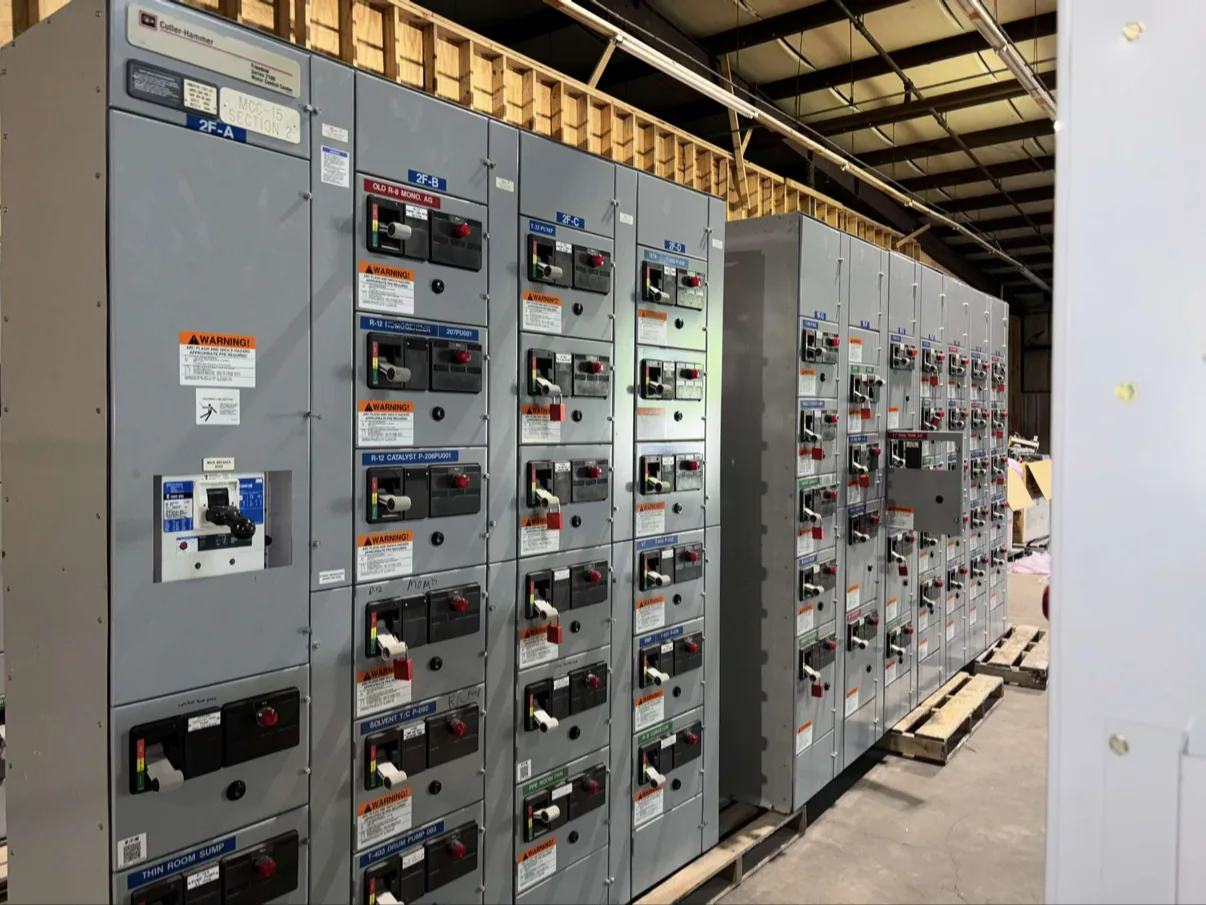
Multi-section NEMA line-ups fully loaded with starters, back-to-back and front-only arrangements, with main breaker or main lug incoming sections. Allen-Bradley CENTERLINE, Square D Model 6, GE 8000 and Eaton Freedom line-ups all have deep aftermarket demand.
Buckets, starters and drives
Individual starter buckets from size 0 through size 6, reversing and two-speed units, VFD buckets, soft starters, feeder and lighting buckets, and the loose units sitting in your spares room. Buckets sell faster than line-ups and are the easiest MCC item to move.
New York specifics
New York is two completely different jobs sharing a state line. In the five boroughs and the lower Hudson Valley the work is vertical and permit-heavy: switchboards and busway risers coming out of pre-war commercial buildings, hospital and university plants replacing essential-power systems, and Con Edison network gear on a renewal cycle that never really stops. Freight elevators, night windows and street-level staging decide the schedule far more than the rigging does. Upstate is horizontal and industrial — the Buffalo and Niagara Falls electrochemical and metals legacy, Rochester optics and imaging plants that have been shedding infrastructure for two decades, Syracuse and Utica manufacturing, and the semiconductor and battery build-out that is now retiring the gear it replaced. Bus duct is unusually common in both halves, because so much of this building stock was wired when busway was the standard answer.
Nearby
Nearby and related
New York routes with these nearby New York sites:
Common questions
New York questions
What is the smallest job you will take in New York?
A single transformer, one switchgear section, a pallet of breakers or a few boxes of breakers is worth a call. Because we route crews across New York continuously, small New York pickups usually get added to an existing run rather than priced as a dedicated trip.
How fast can you get to a New York site?
Written offers go out the same business day in nearly every case. After acceptance, typical mobilization to New York is a few business days for a straightforward removal and one to two weeks for a full plant scope that needs phasing, rigging plans or utility coordination.
Do we have to disconnect the equipment before you arrive?
No. We handle removal. Your electrician or the utility performs the final isolation and we verify it; from there our crews lock out, cut and cap cable at the gland, unbolt the sections, skate them out and load them. If the New York room is still partly live we phase the work.
How do you handle transformer oil in New York?
Oil is tested, drained and manifested through licensed handlers, and you receive the documentation with your paperwork. PCB-suspect units go under a separate waste profile. Nothing is left on your pad in New York and nothing gets dumped — the handling cost is already in the offer.
When do we get paid?
Before the equipment leaves your New York dock. Wire, company check or cashier's check, whichever your accounting group prefers. On large phased projects we pay per load as it ships rather than holding everything until the end.
Motor Control Centers in New York?
One call, one written offer, one crew. Payment before the trailer leaves.